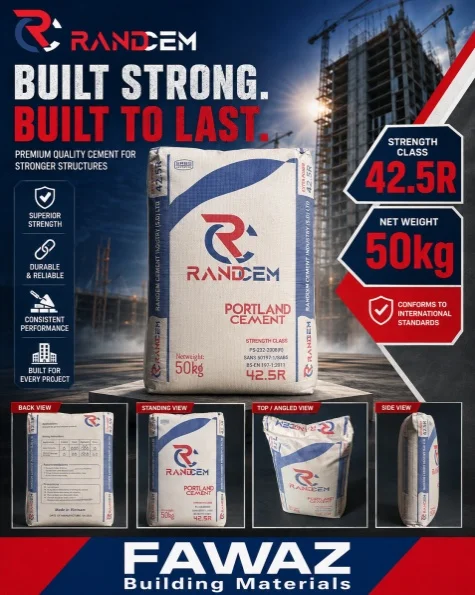
FAWAZ Building Materials has announced its continued distribution of RANDCEM 42.5R Cement across Sierra Leone, aiming to meet the rising demand for construction materials. The company stated this initiative contributes to national development by enhancing access to dependable building supplies. This increased availability comes as Sierra Leone experiences growing investment in housing and infrastructure, which necessitates reliable cement and other materials for strong, safe, and durable structures. The company specifically noted that its continued distribution of RANDCEM 42.5R Cement represents a significant part of its contribution to national development by improving access to dependable construction materials key for these projects. Growing investment in housing and infrastructure across Sierra Leone is indeed increasing demand for reliable cement and other building materials capable of supporting strong, safe, and durable structures, making FAWAZ's efforts particularly timely.
Product Specifications and Applications
RANDCEM cement is manufactured in Vietnam and supplied in 50-kilogram bags, carrying a 42.5R strength classification. This classification indicates its high early strength development, making it suitable for projects requiring rapid progress and strong structural integrity. The product is designed for a wide range of concrete and masonry works, including foundations, columns, beams, floors, concrete blocks, and other structural applications. Its versatility makes it a valuable component for various construction needs, from residential buildings to larger infrastructural developments. According to FAWAZ Building Materials, RANDCEM offers dependable early strength and consistent performance when properly mixed and applied, ensuring that builders can rely on its quality for long-lasting results.
The cement reportedly starts setting within approximately 30 minutes under suitable working conditions, a characteristic that can significantly aid in project timelines and efficiency. This rapid setting time allows for quicker progression between construction stages, which is beneficial for both large-scale projects and individual home builds. For ordinary concrete work, a general mixture of one part cement, two parts sand, and four parts aggregate is commonly used, providing a standard and effective composition for a wide array of construction tasks. Lean concrete applications, which are often used for foundations or non-structural elements where less strength is required, may necessitate a different ratio, typically one part cement, three parts sand, and six parts aggregate. Understanding these precise mixing ratios is key for achieving the desired strength and durability in different construction scenarios.
Addressing Construction Concerns
Public concern over building collapses in Sierra Leone has intensified calls for improved construction standards and stronger accountability within the building industry. These incidents show the critical need for high-quality materials and stringent adherence to building codes. Industry stakeholders have consequently urged the Sierra Leone Standards Bureau and other relevant authorities to strengthen market inspections, ensuring that all construction materials meet national and international quality benchmarks. These stakeholders also advocate for regular laboratory testing of construction materials to ensure compliance with quality specifications, thereby preventing substandard products from entering the market. The calls reflect a broader demand for enhanced oversight to safeguard public safety and infrastructure integrity across the nation, making the availability of certified materials like RANDCEM even more important.
FAWAZ's Commitment to Quality
FAWAZ Building Materials is expanding the availability of RANDCEM 42.5R Cement across Sierra Leone, according to the company. The expanded distribution aims to cater to a broad spectrum of construction professionals and projects within the country, ranging from urban centers to more remote areas. This includes contractors, engineers, and property developers engaged in large-scale commercial and public works, such as new office buildings, bridges, and public housing initiatives. Masons and individuals undertaking residential construction projects are also among the target beneficiaries for the increased supply, ensuring that everyday builders have access to reliable materials for their homes and smaller structures. The initiative seeks to ensure that these various stakeholders have consistent access to the cement for their building needs, supporting both economic growth and social development. The company stated that this effort is part of its commitment to supporting the construction sector and national development goals in Sierra Leone, providing essential resources for the country's ongoing growth and modernization.