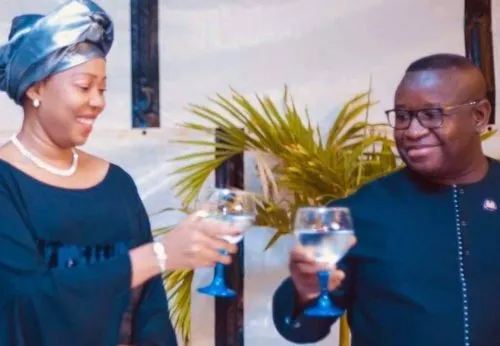
Sierra Leone’s First Lady, Mrs. Fatima Bio, is under intense scrutiny regarding her eligibility for public office and past associations, with a growing number of questions arising about her citizenship status and her controversial stance on female circumcision. Mrs. Bio is reportedly defending her position on female circumcision following a BBC interview, where she addressed the contentious issue. Claims have emerged suggesting that Mrs. Fatima Bio is not only a Gambian citizen but also holds British citizenship, raising significant legal and political concerns. These claims are particularly significant because Section 76(1) of the Sierra Leone constitution explicitly stipulates that a person is not qualified to be a Member of Parliament if they hold dual citizenship or are a naturalized citizen of Sierra Leone or a citizen of another country. This constitutional provision aims to ensure undivided loyalty to the nation from its public officials. Additionally, Mrs. Bio, also known as Jabbe-Bio, has repeatedly refused to condemn female genital mutilation (FGM) and has argued publicly that she does not believe the practice is inherently harmful, a position that has drawn widespread criticism from human rights organizations and women's advocates both domestically and internationally.
Eligibility Questions Arise
Further questions are being raised about Mrs. Fatima Bio's legitimacy to become president of Sierra Leone after her husband, Julius Maada Bio, leaves office in 2028, a potential political aspiration that has fueled much of the current debate. Sierra Leone's constitution requires presidential candidates to meet the same stringent citizenship requirements as parliament members, which specifically prohibits dual citizenship. This constitutional provision means that any individual seeking the highest office in the land must not hold citizenship in another country. The implications of this rule are profound for Mrs. Bio, given the allegations of her Gambian and British nationalities.
The constitution of the Sierra Leone People’s Party (SLPP), the ruling party, further stipulates that only those holding senior leadership roles within the party are eligible to be presidential candidates. These roles include members of the national executive committee and the current vice president, outlining a clear path for succession and eligibility within the party structure. For Mrs. Bio to be eligible for the presidency, she would need to renounce her Gambian and British citizenships, according to reports and constitutional experts, a process that would involve formal legal steps to sever ties with her alleged foreign nationalities. The requirement for presidential candidates to be solely citizens of Sierra Leone shows a national commitment to sovereignty and the avoidance of potential conflicts of interest. The potential for Mrs. Bio to seek the presidency has therefore brought these constitutional and party-specific eligibility criteria into sharp focus, sparking considerable public discussion and debate about her future political ambitions.
Mrs. Bio met Julius Maada Bio in London in 2012, a significant turning point in her life. The couple married a year later, embarking on a journey that would eventually lead her to the role of First Lady. The ongoing discussions around her eligibility highlight the complex constitutional and party-specific hurdles she would inevitably face if she were to pursue the highest office in Sierra Leone, necessitating a thorough examination of her citizenship status and adherence to all legal requirements. The scrutiny over her eligibility is not merely a political debate but a fundamental question about adherence to the foundational laws governing public service and leadership in Sierra Leone.
London Council Flat Controversy
Adding to the scrutiny, questions have arisen regarding Mrs. Fatima Bio's tenancy of a London council property while she was simultaneously living in Sierra Leone. The Times newspaper revealed that Fatima Jabbe-Bio had been improperly using a council flat in Southwark, London, a property specifically intended for the city’s poorest residents who are in genuine need of affordable housing. The newspaper referenced a previous report from May 11, 2025, which had initially stated that Fatima Bio was a tenant of a two-bedroom council flat in Southwark, bringing the issue to public attention. The UK Times later reported that her London council tenancy has since been revoked, indicating a successful legal process by the council to reclaim the property.
She had reportedly lived in the two-bedroom flat for over a decade, from 2008 until her departure in 2018 when she moved to Sierra Leone to assume her role as First Lady. The Southwark council announced on Wednesday that, following a careful 12-month investigation into the matter, it had successfully taken possession of the property, concluding a lengthy legal battle. Reginald Popoola, Southwark’s executive member for council homes, issued a statement expressing the council's commitment to its residents, saying, "I look forward to bringing this council property back to its original purpose which is to provide a safe and secure home for people with legitimate housing needs on the council’s waiting list." The council further indicated that the property would be promptly allocated to a local family in genuine need, emphasizing the importance of fair access to social housing.
The severity of the housing crisis in Southwark shows the public outrage surrounding the case. Southwark currently has over 18,000 households on its waiting list for social housing, with a significant number, 4,000 of these families, living in temporary accommodation, noting the acute demand for affordable housing. In an interview with the BBC last month, Mrs. Bio defended her eligibility for social housing, asserting, “My children are all British citizens. I’m paying for my council house myself. I have not committed any crime.” When pressed further on the matter by a journalist regarding the appropriateness of her tenancy given her status, Fatima Jabbe-Bio stated, "I would have loved to answer you but honestly I am not going to waste my precious time. If you are looking for a slave I am not one of them," a response that drew further criticism for its perceived dismissiveness.
The controversy also attracted political attention from outside the council. Robert Jenrick, Reform UK’s Treasury spokesman, visited the property and recorded a social media video, drawing national attention to the issue. In the video, Jenrick pledged to “boot [her] out” if Reform UK were to form the next government, indicating the political weight and public interest in the case. Public records indicate that Tigda Soley, the first lady’s daughter from a previous marriage, was registered to vote at the Southwark address in 2023, further linking the family to the property even after Mrs. Bio's move to Sierra Leone. The entire episode surrounding the council flat has raised serious questions about accountability, integrity, and the appropriate use of public resources by individuals in positions of power.
Past Associations and Financial Allegations
Beyond the citizenship and housing controversies, Mrs. Fatima Bio is also facing persistent questions regarding her relationship with 'Europe’s most wanted cocaine fugitive – Bolle Jos', an association that has drawn significant concern and speculation. These inquiries delve into the nature and extent of any past or present connections, raising red flags about the potential implications for her public role. Further financial scrutiny has been directed at the Office of the First Lady, which is reportedly in receipt of millions of dollars in public funds. Critics have described these financial dealings as unaccountable and opaque, leading to accusations of corruption and a lack of transparency in the management of public money. A detailed report by the Organised Crime and Corruption Reporting Project (OCCRP) further alleged that the first lady owns an extensive property portfolio, spanning multiple countries, which has only intensified calls for greater financial disclosure and accountability.
Jabbe-Bio has been vocal in her opposition to child marriage, sexual violence, and what she perceives as Western interference in African affairs, using her platform to advocate for these causes. Her outspokenness on these issues has drew both support and criticism, positioning her as a prominent figure in discussions about social justice and pan-Africanism. However, these advocacy efforts are often overshadowed by the allegations surrounding her personal finances and past associations.
She is alleged to own properties not only in Sierra Leone but also in the Gambia, Senegal, and Ghana, suggesting a significant personal wealth that has come under the spotlight. Prior to her role as First Lady, Jabbe-Bio, now 45, appeared in a number of low-budget Nigerian films, showcasing an earlier career in the entertainment industry. When asked to comment on her participation at an event, Jabbe-Bio reiterated her earlier dismissive stance, stating, "I would have loved to answer you but honestly I am not going to waste my precious time. If you are looking for a slave I am not one of them." This response has been interpreted by some as an avoidance of legitimate journalistic inquiry, further fueling public skepticism. Despite the mounting scrutiny and various controversies, she was named 2024’s "first lady of the year" at the London Political Summit and Awards, an accolade that has itself become a point of contention given the ongoing allegations against her. The combination of these various issues continues to place Mrs. Fatima Bio at the center of public and political debate in Sierra Leone and beyond.