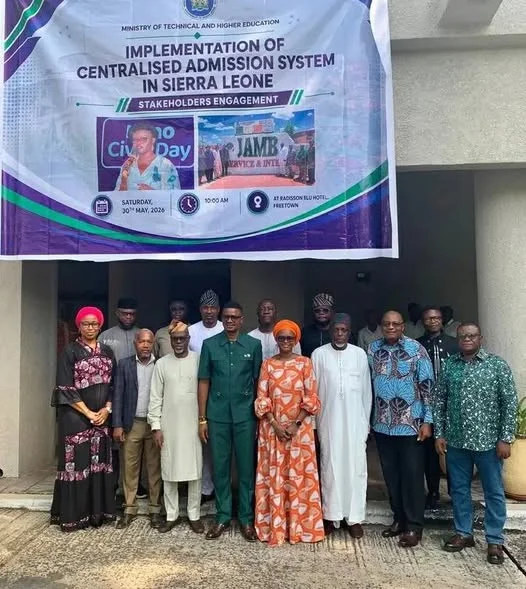
Sierra Leone's Ministry of Technical and Higher Education (MTHE) engaged key stakeholders on May 30, 2026, regarding the implementation of a proposed Centralized Admissions System (CAS). The high-level engagement occurred at the Radisson Blu Hotel in Freetown.
The Centralized Admissions System (CAS) is a reform initiative designed to transform higher education admissions across Sierra Leone. The MTHE's initiative has already received Cabinet approval. The system is supported by provisions within the Universities Act of 2021, providing a legal framework for its establishment.
System Design and Functionality
The Centralized Admissions System (CAS) aims to improve coordination and efficiency within the higher education sector without diminishing the individual roles of institutions and other stakeholders. Under the proposed system, students would apply for university placement during their penultimate year of secondary school. This early application window would allow students to receive conditional admission offers before they sit for their final examinations.
Admissions would be finalized through an integrated digital platform designed to link directly with the West African Examinations Council (WAEC) results system. The system's scope extends beyond traditional universities, as it is also designed to cater to Technical and Vocational Education and Training (TVET) institutions. To manage these operations, plans include establishing a dedicated Centralized Admissions Secretariat within the Ministry of Technical and Higher Education.
Deputy Minister of Technical and Higher Education, Sarjoh Aziz-Kamara, stated, "the proposed Centralized Admissions System is firmly grounded in the Universities Act of 2021." This legislative backing provides the legal framework for the system's establishment and operation, ensuring its integration into the national education landscape.
Stakeholder Engagement and Support
The Ministry of Technical and Higher Education (MTHE) engaged various stakeholders, including university vice-chancellors, principals of technical and vocational institutions, and representatives from civil society organizations, to discuss the planned Centralized Admissions System (CAS). The discussions aimed to gather feedback and build consensus for the initiative. Among the attendees was Professor Is-haq Oloyede, the Registrar of Nigeria's Joint Admissions and Matriculation Board (JAMB), who shared insights from Nigeria's experience with a centralized admissions process. Nigeria established its centralized admissions system in 1978.
Mr. Emmanuel J. Momoh Esq. Representing the Sierra Leone Bar Association, emphasized the importance of transparency and fairness in the proposed system. He noted the need for an appeals process to ensure that all applicants have recourse if they believe their applications were unfairly handled. Sia Fasuluku, representing the National Union of Sierra Leone Students (NUSS), voiced support for the CAS, stating, "We welcome this initiative as it promises to streamline the admissions process and reduce the challenges students currently face." Fasuluku also stressed the importance of timely communication with students regarding their application status and admission decisions.
Dr. Haja Ramatulai Wurie, a representative from the Tertiary Education Commission (TEC), showed the necessity of strong data management within the CAS. She suggested that the system should not only facilitate admissions but also provide valuable data for educational planning and policy formulation. Dr. Josephus Brimah, Chairman of the Conference of Principals of Secondary Schools, expressed optimism that the CAS would alleviate the administrative burden on individual institutions and allow them to focus more on academic quality. He added that a unified system could also help in identifying national educational needs and resource allocation.
Professor Edwin J.J. Momoh, Vice-Chancellor of Njala University, commended the MTHE for its proactive approach in consulting stakeholders. He noted that incorporating feedback from various educational bodies would be key for the successful implementation and long-term sustainability of the CAS. Peter J. Sandy, from the Sierra Leone Association of University Administrators, raised concerns about the technical infrastructure required for the system, advocating for adequate investment in technology and staff training to ensure smooth operations. Matilda Jusu, of the Sierra Leone Teachers Union, offered support but underlined the need for clear guidelines for secondary schools on how to prepare students for the new application process. Professor Osman Sankoh, Statistician General, emphasized the potential of the system to improve national data collection on higher education. Abdul Ben Foday, a representative from the National Council for Civil Society, welcomed the initiative, viewing it as a step towards greater equity in access to higher education across the country. Mohamed Massaquoi, from the National Youth Commission, noted the importance of accessibility for students in remote areas, urging for digital inclusion efforts to accompany the system's rollout.
Addressing Challenges and Future Vision
Stakeholders acknowledged several challenges that would need to be addressed for the successful implementation of the Centralized Admissions System (CAS). Peter J. Sandy, from the Sierra Leone Association of University Administrators, raised concerns regarding the technical infrastructure required for the system. Sandy advocated for adequate investment in technology and staff training to ensure smooth operations. Similarly, Mohamed Massaquoi, representing the National Youth Commission, noted the importance of accessibility for students in remote areas, urging for digital inclusion efforts to accompany the system's rollout.
Emmanuel J. Momoh Esq. Representing the Sierra Leone Bar Association, emphasized the need for transparency and fairness within the proposed system. He noted the importance of an appeals process to ensure that applicants have recourse if their applications are perceived as unfairly handled. Sia Fasuluku, of the National Union of Sierra Leone Students (NUSS), stressed the importance of timely communication with students regarding their application status and admission decisions once the system is operational.
Looking ahead, Dr. Haja Ramatulai Wurie, a representative from the Tertiary Education Commission (TEC), showed the necessity of strong data management within the CAS. She suggested the system should not only facilitate admissions but also provide valuable data for educational planning and policy formulation. Professor Osman Sankoh, Statistician General, also emphasized the potential of the system to improve national data collection on higher education. Dr. Josephus Brimah, Chairman of the Conference of Principals of Secondary Schools, expressed optimism that the CAS would alleviate administrative burdens on individual institutions, allowing them to concentrate more on academic quality. He added that a unified system could also aid in identifying national educational needs and resource allocation. Abdul Ben Foday, from the National Council for Civil Society, welcomed the initiative as a step towards greater equity in access to higher education across the country.