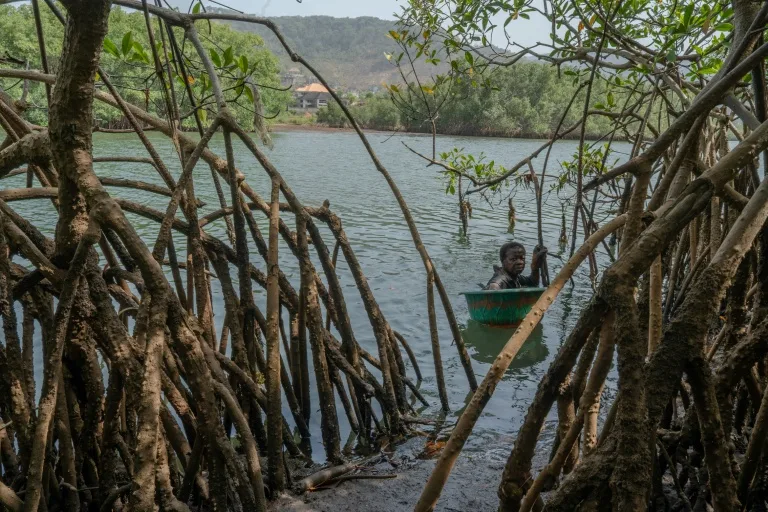
Millicent Turay, a 50-year-old oyster harvester, has supported her family for 20 years by collecting mangrove oysters near Sierra Leone's capital, Freetown, a traditional livelihood now threatened by vanishing mangrove ecosystems. This practice, deeply embedded in the cultural fabric of coastal communities, is facing unprecedented challenges. Official estimates indicate that more than 25 percent of the country's mangrove cover has disappeared since 1990, a stark indicator of the environmental pressures at play.
Turay stated that the women learned "how to do it for ourselves... To survive," describing the work as "physically demanding." She explained their process, saying, "After harvesting, we usually steam it in a pot using mangrove wood." This method not only provides a source of food but also relies directly on the health and availability of the mangrove environment. However, the availability of mangroves is diminishing. "Now, people cut [the mangroves] down," Turay said, adding, "We don't know why they do this... Because that's how we find our living. They say they're doing it to get the land." The loss of these vital ecosystems has profound implications for the women who depend on them.
The Oyster Harvesters' Struggle
Millicent Turay, now 50 years old, earns approximately $7 a day during a good harvest, a vital income for her family. This income is key for her household, noting the direct economic impact of environmental degradation on local populations. Her work is part of a traditional harvesting technique practiced in mangroves across several West African countries, showing the regional significance of this issue. Turay described the work as "physically demanding," requiring resilience and deep knowledge of the tidal environment. She explained, "After harvesting, we usually steam it in a pot using mangrove wood," a practice that has been passed down through generations. The methods are self-taught, with Turay stating, "We learnt how to do it for ourselves... To survive." This self-reliance emphasizes the community's deep connection to their environment. However, the availability of mangrove wood is declining due to deforestation. "Now, people cut [the mangroves] down," Turay said, expressing bewilderment at the reasons. "We don't know why they do this... Because that's how we find our living. They say they're doing it to get the land." The encroachment on these natural habitats for other uses directly threatens the traditional way of life for many. In response to the widespread destruction, the government and various village communities have initiated mangrove replanting schemes, recognizing the urgent need for conservation. These efforts represent a collaborative approach to restoring the vital coastal ecosystems.
Drivers of Mangrove Loss
Sierra Leone's wildlife faces severe threats stemming from deforestation, unchecked urban growth, and other forms of human activity. These pressures contribute to the degradation of critical ecosystems across the country, impacting biodiversity and natural resources. The rapid expansion of urban areas, particularly around Freetown, places immense strain on surrounding natural habitats. Aberdeen Creek, located near Freetown, is particularly affected, despite its recognition as a wetland of international importance for waterbirds. This designation notes its ecological value, making the ongoing habitat loss a pressing concern not just locally but globally. The creek serves as a key habitat for numerous avian species, and its degradation threatens this delicate ecological balance.
Efforts to mitigate the decline in mangrove ecosystems and support local livelihoods are underway. Nature for Mangroves, for instance, implements a specific restoration technique. The organization constructs bamboo structures that are then strung with ropes. These ropes are designed to hold oyster shells and coconut husks, which serve to attract wild oysters, thereby promoting their growth and contributing to the regeneration of the marine environment. This innovative method aims to assist in the recovery of oyster populations, which are intrinsically linked to healthy mangrove habitats. Such initiatives are key in addressing the multifaceted drivers of mangrove loss and their impact on both the environment and the communities dependent on these vital coastal ecosystems. These restoration projects not only aim to bring back the mangroves but also to ensure the long-term sustainability of the livelihoods that depend on them.
Community and NGO Efforts
Mangrove cover in the Aberdeen coastal area, on Freetown's outskirts, significantly declined from 537 hectares in 2017 to 458 hectares by February 2025, according to data from the Environmental Justice Foundation (EJF) NGO. This alarming reduction shows the rapid pace of environmental degradation in this critical region. The EJF is actively involved in conservation efforts, cultivating oyster larvae to establish an 'oyster farm' designed to aid in mangrove restoration and support local livelihoods. This approach recognizes the symbiotic relationship between oysters and mangroves, where healthy oyster populations can contribute to the overall health of the mangrove ecosystem.
Abubakarr Barrie, co-founder of the NGO Nature for Mangroves, noted the critical importance of these ecosystems. Barrie stated, "If we don't protect our mangroves, millions of coastal residents around the world including Kolleh Town are at risk of not having sustainable livelihoods." His statement emphasizes the global implications of mangrove loss, extending beyond Sierra Leone to numerous coastal communities worldwide. The organization's initiatives aim to address both ecological degradation and the economic security of communities dependent on healthy mangrove habitats. By engaging local communities in these restoration efforts, organizations like Nature for Mangroves are fostering a sense of ownership and promoting sustainable practices for the future.